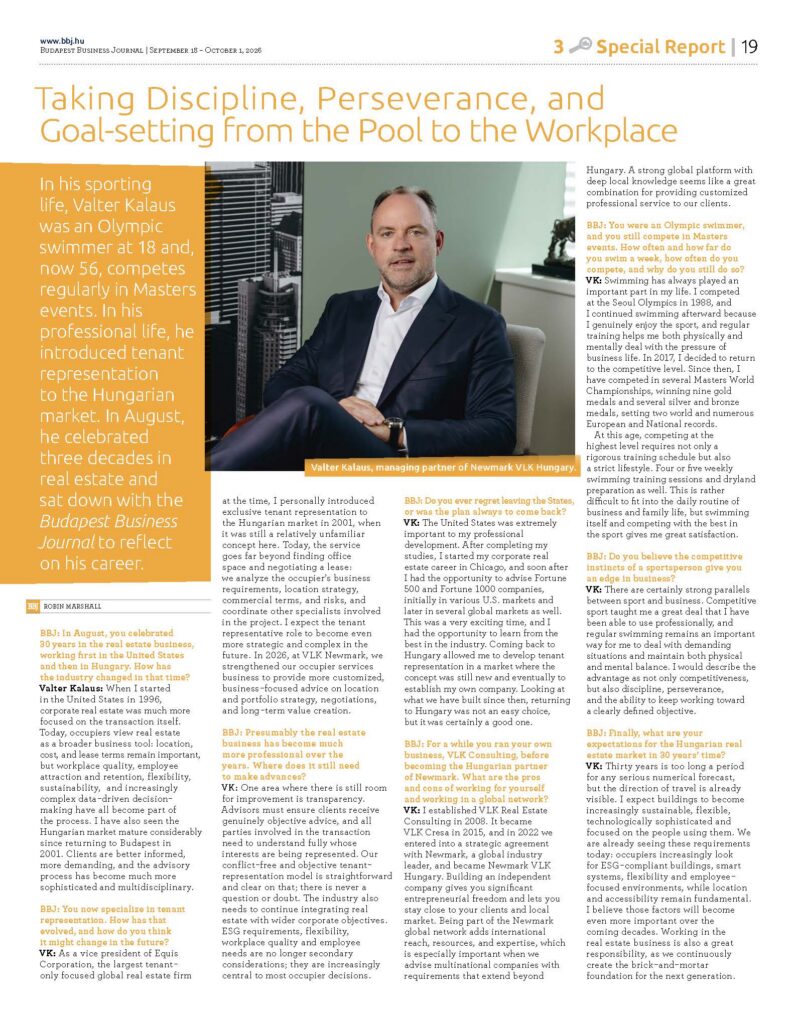
In his sportingclife, Valter Kalaus was an Olympic swimmer at 18 and, now 56, competes regularly in Masters events. In his professional life, he introduced tenant representation to the Hungarian market. In August, he celebrated three decades in real estate and sat down with the Budapest Business Journal to reflect on his career.
1) In August, you celebrated 30 years in the real estate business, working in both the United States and then Hungary. How has the industry changed in that time?
When I started in the United States in 1996, corporate real estate was much more focused on only the transaction itself. Today, occupiers look at real estate as a much broader business tool: location, cost and lease terms remain important, but workplace quality, employee attraction and retention, flexibility, sustainability and increasingly complex data-driven decision-making have all become part of the process.
I have also seen the Hungarian market mature considerably since returning to Budapest in 2001. Clients are better informed, more demanding and the advisory process has become much more sophisticated and multidisciplinary.
2) You now specialize in tenant representation. How has that evolved, and how do you think it might change in the future?
As a Vice President of Equis Corporation, the largest tenant-only focused global real estate firm at the time, I personally introduced exclusive tenant representation to the Hungarian market in 2001, when it was still a relatively unfamiliar concept here. Today the service goes far beyond finding an office space and negotiating a lease: we analyse the occupier’s business requirements, location strategy, commercial terms and risks, and coordinate other specialists involved in the project.
I expect the role of a tenant representative to become even more strategic and more complex in the future. In 2026 at VLK Newmark, we strengthened our Occupier Services business specifically to provide more customized and business-focused advice covering location and portfolio strategy, negotiations and long-term value creation.
3) Presumably the real estate business has become much more professional over the years. Where does it still need to make advances?
One area where there is still room for improvement is transparency. Advisors have to ensure that their clients receive genuinely objective advice and all involved parties in the transaction need to fully understand whose interests are being represented. Our conflict-free and objective tenant-representation model is stratightforward and clear on that, there is never a question or doubt.
The industry also needs to continue integrating real estate with wider corporate objectives. ESG requirements, flexibility, workplace quality and employee needs are no longer secondary considerations; they are increasingly central to most occupier decisions.
4) Do you ever regret leaving the States, or was the plan always to come back?
The United States was extremely important to my professional development. After completing my studies, I started my corporate real estate career in Chicago and not much later I had the opportunity to advise Fortune 500 and Fortune 1000 companies, initially in various US markets then in several global markets as well. This was a very exciting time and I had the opportunity to learn from the best in the industry.
Coming back to Hungary gave me the opportunity to develop tenant representation in a market where the concept was still new and eventually to establish my own company. Looking at what we have built since then, I certainly see returning to Hungary was not an easy but certainly a good choice.
5) For a while you ran your own business, VLK Consulting, before becoming the Hungarian partner of Newmark. What are the pros and cons of working for yourself and working in a global network?
I established VLK Real Estate Consulting in 2008. It became VLK Cresa in 2015, and in 2022 we entered into a strategic agreement with Newmark, a global industry leader and became Newmark VLK Hungary.
Building an independent company gives you a great deal of entrepreneurial freedom and allows you to stay very close to your clients and your local market. Being part of the Newmark global network adds international reach, resources and expertise, which is particularly important when we are advising multinational companies with requirements, especially extending beyond Hungary. A strong global platform with a deep local knowledge seems to be a great combination to provide customized professional service to our clients.
6) You were an Olympic swimmer, and you still compete in Masters events. How often and how far do you swim a week, how often do you compete, and why do you still do so?
Swimming has always played an important part of my life. I competed at the Seoul Olympics in 1988, and I have continued swimming afterwards because I genuinely enjoy the sport and regular training helps me both physically and mentally in dealing with the pressure of the business life.
In 2017 I have decided to return to the competitive level. Since then I have competed in several Masters World Championships winning 9 gold medals and several silver and bronze medals, setting 2 World records and numerous European and National records.
At this age competing at the highest level requires not only a very rigorous training schedule but a very strict life style as well. 4-5 weekly swimming trainings and dryland preparation as well. This is rather difficult to fit into the daily rutine of the business and family life but swimming itself and competing with the best in the sport gives me great satisfaction.
7) Do you believe the competitive instincts of a sportsperson give you an edge in business?
There are certainly strong parallels between sport and business. Competitive sport taught me a great deal that I have been able to use professionally, and regular swimming remains an important way for me to deal with demanding situations and maintain both physical and mental balance.
I would probably describe the advantage as being not only competitiveness, but also discipline, perseverance and the ability to keep working towards a clearly defined objective.
8) Finally, what are your expectations for the Hungarian real estate market in 30 years’ time?
Thirty years is too long a period for any serious numerical forecast, but the direction of travel is already visible. I expect buildings to become increasingly sustainable, flexible, technologically sophisticated and focused on the people using them.
We are already seeing these requirements today: occupiers increasingly look for ESG-compliant buildings, smart systems, flexibility and employee-focused environments, while location and accessibility remain fundamental. I believe those factors will become even more important over the coming decades. Working in the real estate business is also a great responsibility as we continuously create the brick and mortar foundation for the next generation.
To read more click on the following link: https://bbj.hu/business/the-latest-issue-of-the-budapest-business-journal/