• About
    • About
    • Meet the team
    • Tenant representation
    • Career
    • Awards
  • Our services
    • Transaction services
    • Project management
    • Workplace solution
    • Legal Services
    • Service charge audit
    • Valuation
    • Capital Markets
  • Sectors
    • Offices
    • Industrial & Logistics
    • Retail
    • Hotel & Tourism
  • Clients
    • Success stories
    • Videos
  • Knowledge
  • Contact
  • HU
  • Rólunk
    • Rólunk
    • Csapatunk
    • Bérlőképviselet
    • Karrier
    • Elismerések
  • Szolgáltatásaink
    • Tranzakciómenedzsment
    • Műszaki projektmenedzsment
    • Munkahelyi környezetoptimalizálás
    • Ingatlanjogi tanácsadás
    • Üzemeltetési költségvizsgálat
    • Értékbecslés
    • Ingatlanbefektetés
  • Szektorok
    • Iroda
    • Ipari és Logisztika
    • Kiskereskedelem
    • Hotel és turizmus
  • Ügyfelek
    • Sikersztorik
    • Videók
  • Tudástár
  • Kapcsolat
  • HU

Author Archive for Vass Emőke – Page 6

Top Real Estate Executives 2021 – Valter Kalaus

By Vass Emőke
Wednesday, August 11th, 2021

The Top Real Estate Executives magazine is a special annual publication of the Budapest Business Journal.

The magazine presents the profiles of the most influential real estate executives in the Hungarian economy. It puts a human face on the local development market, focusing on leading personalities’ profiles and outstanding achievements. We also look at incentives and tax breaks for construction, and examine how the Hungarian market is developing, among other things. The selection is unashamedly subjective, having been made by the editorial team of the Book of Lists and the BBJ, and draws on our 28-year-history of providing unparalleled business news and analysis. The readership of Top Real Estate Executives mirrors much of that of the BBJ, including many of the country’s leading business executives, diplomats and decision makers.

VALTER KALAUS
Managing Director of Newmark VLK Hungary

Valter Kalaus Top Real Estate Executive in HU BBJ

You can buy the magazine on the link below.
https://bbj.hu/shop/top-real-estate-executives-2021


Categories : Office, Press

Office Market Talk: Flexibility is Key

By Vass Emőke
Tuesday, May 18th, 2021

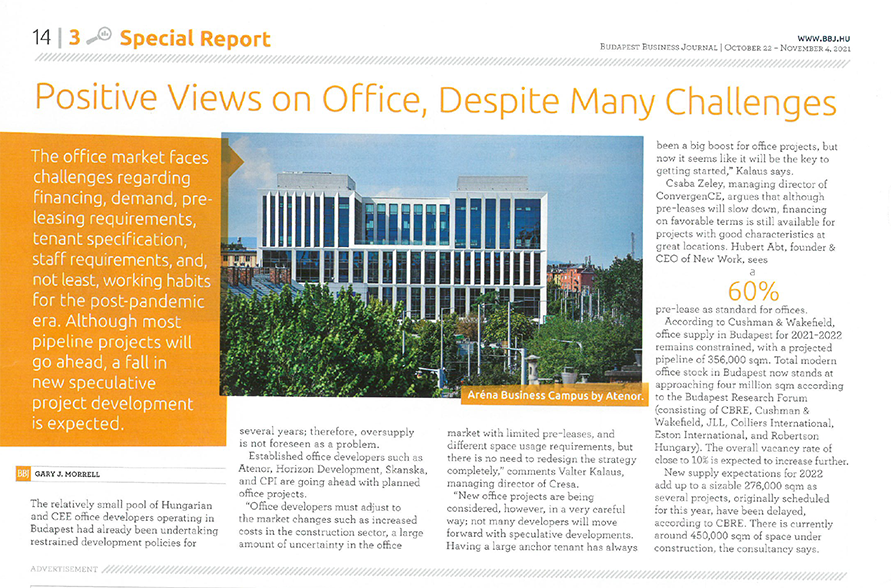
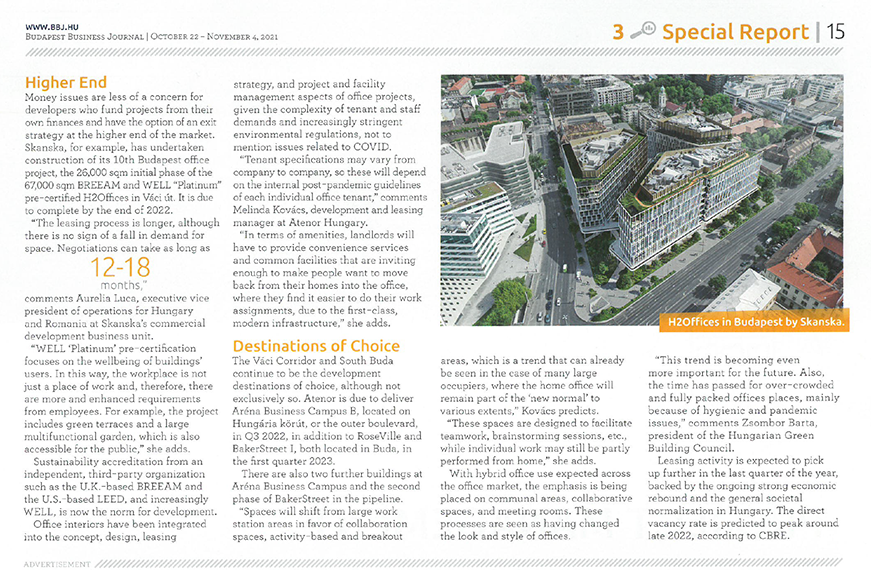
As the office market faces the potential of changes demanded by the post-COVID environment, Budapest must also deal with challenges over demand and supply, developing expectations from tenants, and the sourcing of plots in emerging districts of the city. Budapest Business Journal real estate editor Gary Morrell has asked local office market professionals how they see the post-pandemic environment and its impact on demand and potential preleases. Will this encourage the undertaking of new office projects, how are office and remote-based working habits seen in the longer term, and what the role of property management and facility management will be in the new environment? Will the role of sustainability accreditation be enhanced, and what are the potential new business districts?

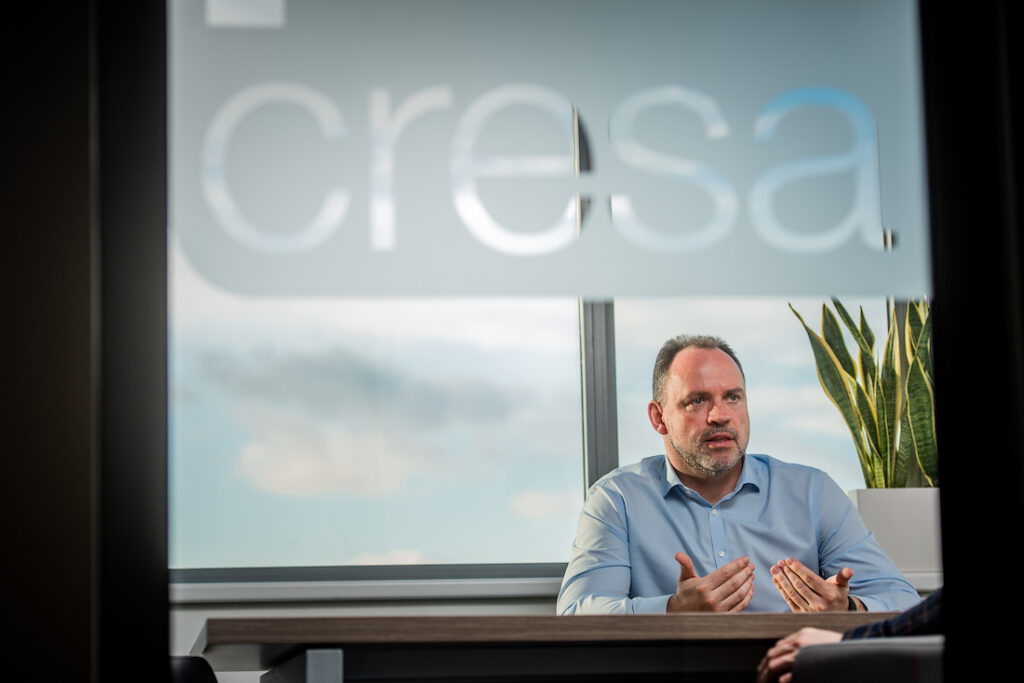
Kalaus Valter VLK Cresa ügyvezető igazgató

We have already overcome the first hurdle; the market has clarified that offices are needed, they will not go away completely. In the post-pandemic world, companies will need to adapt to the new norm, to have a more balanced split between working from home and working from the office. On-site working will prevail, but the home office will be a more substantial part of our life than before COVID. The office environment remains the primary place to work; however, it will have to adapt to the new norms. The internal configuration of offices will have to adapt as well, as people will use the office for partly different purposes than before. But first, employers will have to gain the full confidence of their people and convince them that the office is a safe place to work.

Valter Kalaus
Managing Partner

To read the full article please click here.

BBJ Office article

Categories : Office

Market Pays Tribute to a ‘Daring’ and ‘Inspiring’ Developer

By Vass Emőke
Saturday, March 6th, 2021

The Budapest Business Journal was saddened to learn on the day our last issue was published that Attila Kovács, founder and managing partner of DVM group and Horizon Development, had died aged just 51. Gary Morrell spoke with market players about the architect and developer’s contribution to real estate in Budapest, his promotion of the city and Hungary, and about the man as a person.

https://bit.ly/3vbilgw

Valter Kalaus, managing partner, Newmark VLK Hungary

“Horizon Development has proven that quality makes the difference and that visionary concepts are competitive in each market cycle. Attila was the best ambassador possible for the industry and the city. Not only as a role model but more, designing and developing outstanding buildings and landmarks.”

Categories : Office

Hybrid office models set to become the new norm

By Vass Emőke
Wednesday, February 17th, 2021

Flexibility and effective change-management have become the number one priority in the office market for the past year since the pandemic reached Hungary and restrictions were enacted.

The office market hasn’t collapsed but it has undergone a significant transformation over the past 12 months, and now the new normal has to be redefined, explained Valter Kalaus the managing director of the consulting firm Newmark VLK Hungary.

Kalaus Valter VLK Cresa ügyvezető igazgató‘In the early days, we thought this pandemic wouldn’t last that long, but as time passed by, we’ve realized it can drag on, and we still cannot see the end. Before the pandemic we thought we managed things properly and use appropriate measures, but it turned out that it’s not so obvious. However, both tenants and landlords seem to have recognized the need to redefine what counts as acceptable and normal.’ – he defined the new processes.

Remote working is no longer a rare phenomenon, it has become a common practice across the whole economy. Home office was integrated into the everyday life of companies and everyone tried to find the optimal ratio which suites them.

‘We’ve found that an average company with 100 employees will only want to maintain 60-80 workstations on the long run. In many offices it has become utterly accepted that several people take turns using the same workstation, even within a day.’ – he said, referring to the fact that the secret to success will be the hybrid model in the future.

‘2020 also brought another essential trend for tenants: they had to prioritize creating safe working environments within their offices. While they recognized working from home can be effective, they also changed the perception of working: location-based work has been replaced by productivity-based work, the focus moved to the so-called agile activity.’ – added Valter Kalaus.

The most quoted word on the office market was flexibility last year.

On one hand it meant the rapid adaptation of the new stage for tenants and landlords (or at least the pursuit). On the other hand, that forcing short-term discounts at all costs is not worth it.

‘Asking the landlord for a renewal just to delay their temporary payment problems did not help on tenants being far from their lease expiry. We paid special attention to this as a consulting company. We also saw that tenant requests for flexibility had to be offset by landlords in the same way, as it was essential for both parties to maintain the business. Landlords are doing much more now for their buildings’ safety than ever before. More and more smart buildings and common areas are also managed by contactless solutions. From tenants’ point of view flexibility of lease terms and the size of their office spaces has become predominant today, in many cases it’s already ahead of the rent fee.’ – changes have been revealed by the expert.

The managing director referred to a recent survey, according to which the vast majority of German companies with more than 250 employees are not considering a significant reduction in their office spaces, rather set a goal of restructuring in 2021. This trend can also be observed in Hungary: last year we have seen a trend of rethinking the areas, the reestablishment of meeting rooms and lounges, screens became more common and employees sat more distantly.’ –  he said.

Valter Kalaus also recalled another recent remarkable domestic survey. This has resulted in further strengthening of the busines service centers, which has a significant impact on the office market as 64,000 people already work in this sector in Hungary – not only in Budapest but also in big secondary cities. He believes that multinational giants will further develop these centers in the future, based on the prosperity of existing centers and the recognition of the fundamentals of the Hungarian economy and office market. He added however that the fact that the vacancy rate has increased steadily over the past 12 months should not be hidden. But it is still below compared to most of the European countries.

Categories : Office

You can’t represent both sides at the same time

By Vass Emőke
Monday, February 8th, 2021

Valter Kalaus is admittedly a key player of the Hungarian real estate market: daytime he’s the managing director of VLK Cresa, a significant leader in the Hungarian commercial real estate advisory market, while at dawn he’s training for the next continental race as a professional swimmer. Without sport, he would not be where he stands today, thus VLK Cresa successfully represents a unique business approach on the Hungarian market.

Kalaus Valter VLK Cresa ügyvezető igazgató

Valter gets up at five in the morning to complete his weekly 15–20-kilometer swimming training, then heads to the VLK Cresa office. He returns home from work around 6-7 p.m. to spend the rest of the day with his family. His “self-time” comes after 10 pm, however he has to get up again at five am the next day.

The VLK Cresa MD has been swimming since the age of 5. He was a member of the Seoul Olympic swimming team of Hungary and still competes in the masters category, wining several world-, and European championship titles. Last year he became a board member of the Hungarian Swimming Association strengthening further the Hungarian swimming platform.

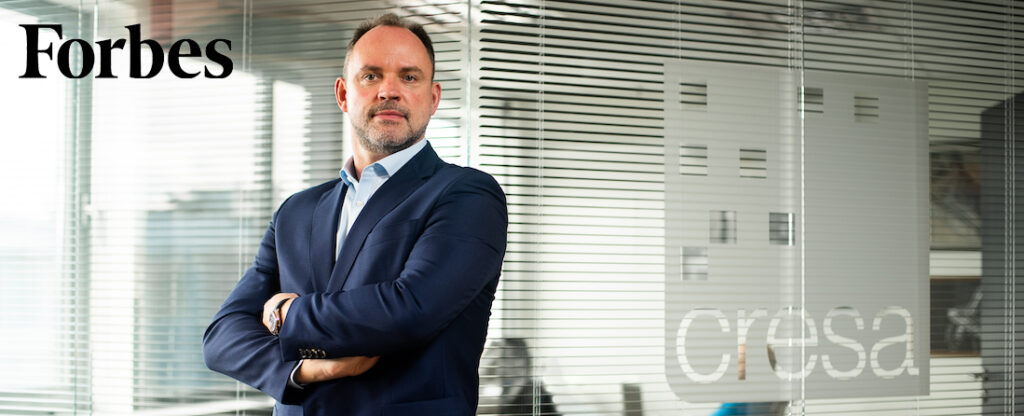
Kalaus Valter VLK Cresa Forbes3

He began his career as a real estate advisor in the US and continued back in Hungary. VLK Cresa is the Hungarian office of the world’s largest real estate consulting firm representing tenants only, which he has been leading since 2014, becoming one of the 50 most influential domestic real estate professionals in 2020.

‘How can you keep the balance between sports and professional career? In brief, it is quite hard.’ admits Valter Kalaus, yet he is certain that without sport he would not have reached the same business success. ‘I’m deeply grateful to my parents that they took me to the swimming pool when I was little, because the professional sport is a perfect mirror of the business world. You learn to win, to lose, you encounter fraudsters and fair situations as well. But primarily, it gives you tremendous self-discipline, willpower, concentration, thus you don’t collapse under pressure.’

In the domestic real estate advisory market, VLK Cresa is the only one who represents tenants only. Other real estate agencies serve both, the landlord and the tenant side at the same time, however according to Valter, it is impossible to represent a tenant effectively, by representing the landlord as well.

‘We offer to find the best real estate solution to fulfill the business needs of the tenants, including if you face a lease renewal, through achieving more favourable lease terms,’ says the managing director. VLK Cresa represents tenants from the assessment of their needs and expectations, through the competition of properties and the negotiation with the landlord, until the handover of the property, and even beyond.

Landlords always have a competitive advantage over tenants, as tenants do not have an extended knowledge of the real estate market, unlike landlords. VLK Cresa not only puts the tenant in a winning position during the negotiations when planning to move through his expertise, but by thoroughly surveying the company’s functions it can give a more accurate picture of the company’s real business needs, that they could ever map.

According to Valter Kalaus, there is a growing demand for this type of expertise. ‘Many have already realized that the relocation of a company of 100-200 people, the rent of the new property, the cost of conversion/refurbishment is a multi-million-euro decision that requires the help of a professional advisor. Employers understand more and more that apart from financial facts marketing and HR aspects also need to be considered in the real estate decisions. The office space serves as a place of socialization as well, and the appropriate and suitable office boosts the company’s productivity, success, and competitiveness.

‘Companies cannot identify all of these aspects, as this is a separate profession. They can describe their needs, which we can explore, analyze, and translate into the language of the real estate market by a thorough due diligence. Companies often wary of screening, but in the meantime, they also need it – it is easier to highlight factual findings by an external help that would be a hard task for internal communication,’ says the managing director. Valter Kalaus is proud that 95% of Cresa’s clients are returning on the next move, and communication is always mutual with partners even during the out-of-business period.

Categories : Office

The euro exchange rate affects the office rents

By Vass Emőke
Monday, January 18th, 2021

The pursuit of security will be dominant in 2021 for commercial property tenants. One or two old interior design forms are coming back, and the majority of tenants are expected to postpone their office move and extend their contract as a temporary solution, according to a survey of the Newmark VLK Hungary consulting company.

The year started in the spirit of security for the vast majority of office tenants. On the one hand, the tenant companies want to ensure the continuity of their own operations, and on the other hand, to give enough space to the employees who come in the office to work between two days of home office. Waiting became a common approach, with more tenants postponing the move and opting for an extension, even if it is for less years than in the pre-pandemic period – Valter Kalaus, MD of Newmark VLK Hungary summed up the results of the survey.

To find out more contact us.

Categories : Office

The Top 50! The most influential professionals on the Hungarian real estate market

By Vass Emőke
Thursday, December 10th, 2020

2020 brought great changes in the domestic real estate market. Many have been guessing what event, or how and when it will end the unbroken soaring we have been experiencing since 2014, but no one ever imagined that a world pandemic will be the cause, coming from outside the world’s economic process. The defense against Covid-19 has reshaped the real estate market in a few weeks. While some real estate market sectors are struggling for survival, others sectors exploded as an effect of the introduced safety restrictions. However, the majority are waiting, planning, rethinking their market strategy. So life has not stopped, the developments moved ahead, there were market transactions as well, but there is no doubt that we are on the verge of a transformations, that will change the real estate market on the long term. In the spirit of this, this is 5th time in row to present the most important domestic players of the real estate industry, and similar to previous years you can meet company managers, owners, investors, developers here.

Top50 Real Estate Kalaus Valter

Valter Kalaus
The founder and managing director of Newmark VLK Hungary has almost 25 years of comprehensive international experience in corporate real estate consulting and tenant representation. He has assisted a large number of Fortune 500 and Fortune 1000 companies in the USA and various other global real estate markets.

Kalaus Valter VLK Cresa ügyvezető igazgató

Since 2001 he has represented real estate users mainly in the Central European real estate market, in 2008, he joined KPMG as a Director – Real Estate to lead the newly established corporate real estate businessline, then he established VLK Real Estate Consulting the predecessor company that became VLK Cresa in 2015, and Newmark VLK Hungary in 2022.

To read more (HU) click on the following link https://bit.ly/2JlQUhQ

Categories : Office

Market Talk: COVID-related Concerns Underscore Real Estate Sustainability Issues

By Vass Emőke
Tuesday, September 29th, 2020

Sustainability issues have become key elements of the planning, construction and management of office and, increasingly, other commercial properties.

This is in large part due to market pressures, with sustainability demands being made by tenants, who are concerned with staff wellbeing, productivity and retention. Further, developers and building owners increasingly need to adhere to international and national sustainability regulations regarding energy usage, construction materials and CO2 emissions and the working environment at construction sites. These issues have been given further emphasis by the impact of the coronavirus on office and social behaviour and associated health concerns in the workplace and wider urban environment. From a locational perspective, direct access to public and alternative transportation modes are now a primary requirement for any commercial or business development. The Budapest Business Journal approached several prominent company managers in the real estate industry to comment on what they see as the impact of sustainability on the industry. Sustainability in the COVID-19 environment is further evolving and getting more and more attention, together with the importance of health and safety and contactless technical solutions. Currently, the main focus is on building machinery, especially the air handling systems, which should at the same time be the most energy saving possible, while 100% free of mixing fresh and used air.

Valter Kalaus

Categories : Office, Press

Weerts Group To Start New Warehouse Park Development Near Budapest

By Vass Emőke
Wednesday, July 29th, 2020

Belgian developer purchased a 30-hectares plot from Erste Real Estate, assisted by Newmark VLK Hungary

The logistics sector of Hungary is booming despite the pandemic, foreign investors continue to be optimistic about the market outlook. The latest evidence of the positive sentiment is the major real estate deal made recently between the Belgian Weerts Group and Erste Real Estate with the assistance of Newmark VLK Hungary property consultant. The Belgian developer purchased a 30-hectares land near Ecser, adjacent to the M0 motorway where it is to develop a 120,000 sqm warehouse park.

VLK Cresa Ecser telekeladás

Budapest, Liège, 28 July 2020 – Erste Real Estate Ltd., the property management arm of Erste Bank Hungary has signed a purchase agreement with Weerts Group to sell 30.6 hectares out of its 116-hectares land plot near Ecser.

The Liège-based Weerts Group is a family-owned company active in 3 sectors: contract logistics, real estate, and motorsport. Its contract logistics business is geographically located in Belgium and serves large clients including Audi, Mondelez and BoshSiemensHausgeräte. The company’s real estate activities (which include industrial, office and residential) occur in Belgium, Luxemburg, Germany, Hungary, and Romania.  Fans of motorsports are familiar with the group as it owns WRT which has gained a worldwide reputation as one the leading GT customer racing outfits.

Weerts autó Weerts autó

Weerts Group is currently building ca. 250,000 sqm on various locations in Belgium, Germany, and Hungary, and have secured a pipeline for another circa 300,000 sqm.  The company’s first investment in this area in Hungary is a 46,000 sqm big box project in Nagytarcsa, for which construction is ongoing and which will be delivered in Q1 2021.  The acquisition of the Ecser-plot, where Weerts Gropus plans the development of a 120,000 sqm logistics warehouse park, is part of our strategy to continue and accelerate our growth in this area. Its development projects in Hungary are the largest logistics investment of the company outside Belgium.

„The Ecser investment is a testimony to our group’s long-term commitment to Hungary. Since the beginning of our presence in the country, we have been impressed with the quality of the infrastructure, and the pro-business approach taken by the various public authorities. We strongly believe that the East-Budapest region, with its proximity to the airport, great road infrastructure and availability of skilled labor is the best development area for this type of property in Hungary”, says Pascal Weerts, CEO of Weerts Group.

„This is already our second major deal in Ecser. In April, we sold an 57-acre plot where Jysk retail chain is developing its new local logistics center. We are proud to cooperate with two esteemed multinational companies and support their expansion in Hungary”, commented dr. Andre Gégény, CEO of Erste Real Estate.

„We are witnessing a continuous interest for our Ecser-property, where we still own a 88-hectares plot. We hope to find buyers soon given the excellent location of the plot and the current outstanding performance of the Hungarian logistics sector”, added Melitta Molnár, regional asset manager at Erste Real Estate.

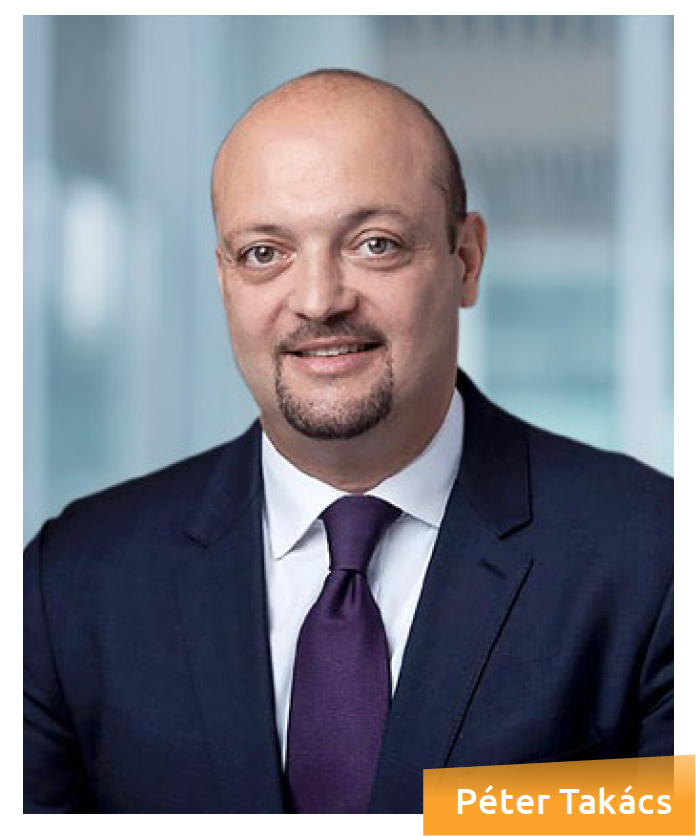
„The Hungarian logistics property market is booming despite the pandemic, and the recent surge in e-commerce is expected to create further demand for warehouse developments. Our optimism is justified by such logistics developments as Weert Group’s in Ecser as the logistics sector provides the blood circulation for the economy. The Erste-Weerts deal signals the optimism of logistics developers. Investors expect that the pandemic will cause a temporary downturn and the economy will bounce back fast”, says Péter Takács, Newmark VLK Hungary partner.

Categories : Industrial logistics, Press

Office subleases becoming more popular – Pandemic effect

By Vass Emőke
Wednesday, July 15th, 2020

Corporations leasing larger office spaces are re-evaluating the use of their property, and they are allowing other companies to occupy 15-20% of their unused floor areas. Subleasing might be attractive to companies looking for a well-equipped office space in a good location, combined with cheaper rent – states Newmark VLK Hungary, the tenant-only advisory firm in their July study.

Besides the popularity of „home office”, the Corona virus pandemic forced company managers to re-evaluate the size of the office space they need on long-term. They are also considering what portion of their office space could be sublet – even temporarily – without making for employees more difficult to return to work or resulting an increase in costs.

The study highlights that many smaller companies have intended to take advantage of this situation, and they want to sublease smaller office spaces – typically 300-400 square metres. Furthermore, many of them have already leased office space in this way. These companies mainly try to sublease space from corporations who rent several thousand square metres, because such corporations want to utilize fast the suddenly „unnecessary” space, and consequently, reduce their expenses.

The main tenant considerations

“It is not typical for large corporations to give back office space to the landlord. The option to sublease is not massively popular yet, but it is definitely a fresh phenomenon. Ten years ago, during the last depression, this phenomenon did not exist, so there is no reference point to go back to. At the same time this is a rational decision from the tenant, because it helps the corporation to reduce their costs by leasing an unused space.” – says Valter Kalaus, managing director of Newmark VLK Hungary.

According to the advisor, it is worth subleasing a part of the office space for corporations who just signed a five-year lease contract. They are not advised to do so if it’s only a half or one year left on the lease contract. Besides it is less likely to find a suitable occupier for a relatively short period of time.

The managing director warns however that the main tenant needs to get the landlord’s consent. As the landlord might consider the potential occupier (subleasing company) undesirable in the building for non-compete reasons, if there is a similar direct occupier in the given office building. Obviously the main tenant has to take all necessary steps to ensure that the sub-tenant fully adheres to all regulations of the building and the leased office space, because he bears material and legal responsibilities. 

The sub-tenants benefit

Companies looking for small office spaces (typically 100-150 m2) cannot really find options to lease in a modern, category „A” office building, in a good location, let alone on lower rent than the official rent. (There are some examples of such transactions, and there are currently similar offers on the market, but these are not very common.) These new office buildings are not designed for this purpose, as the smallest leasable office space is usually minimum 200-250 m2. To break up a smaller area from a larger office space is either physically impossible or is financially not reasonable for the landlord. Lucky is if they manage to find a whole floor (approximately 400-500 m2) from a main tenant who rents several floors in a small- or medium-sized office building – adds the author of the study.

“In spite of all the compromises, there are numerous advantages to be a sub-tenant compared to be a direct tenant in an office building. They can usually choose from properties where they could move in immediately, the office space needs only a few modifications, is already furnished, and has all the necessary cabling installed. And do not forget that the rent could be even 10-20% less as well. A further advantage might be the option to lease for a relatively shorter period, which can be 1-2 or 3 years, as opposed to the typically 5-year long lease contract; depending on the time remaining from the main lease contract. This nearly as flexible as the so called ’serviced office”– confirms Valter Kalaus.

In this context, the study states that serviced offices work for start-up companies or teams which have assembled for a certain project; these are not intended as long-term workplaces. Their advantage is the excellent location; work can be started almost immediately in a completely equipped office environment with reliable back-up support. It is a suitable option for example for start-up companies since they can lease additional space quickly if needed, or it is possible to lease a meeting room only for one occasion.

When is it worth to choose a serviced office?

“Approximately one year is the time limit from which it is worth looking to find a permanent office. Comparing the price of the serviced office with the classic office rents is not recommended, as the two are totally different models. The former may seem more expensive, since they provide full comfort (furniture, back office, IT devices, reception, usage-based fees, flexible time, etc.) but less commitments from the tenant. There is no separate service charge, one-time entry fee, purchase of furniture, IT installations, etc. On the other hand, they provide full flexibility, and actually, this is what needs to be paid”- added Valter Kalaus.

In case of the serviced offices, tenants can choose from: the classic cell office arrangement, which is more favourable now due to the stricter health measures. In this case tenants may control the use of these small offices by allowing to enter that space only to those who are engaged with the project. The other option where there is a co-working area where the community areas are similar to hotel lounges, with the criteria to have separate workstations.

“As the result of the pandemic, these co-working offices face difficulties temporally because there are not to many people who prefer to work in a place where one might get infected, working together in one space with strangers who might be potential virus carriers” – says the managing director of Newmark VLK Hungary.

Findings of this study are supported by the recently issued second quarter market data of the Budapest Real Estate Consultants Conciliation Forum (BRF). According to these, office market demand has significantly fallen in the second quarter, and the number of transactions also shows a remarkable decrease. Vacancy rate has increased to 7.3%, which represents an increase of 1 percentage point on a yearly basis.

Categories : Office, Press
« Previous Page
Next Page »

nmrk.com

Adatkezelési tájékoztató
Honlaphasználati feltételek
Impresszum

Kapcsolat

Newmark VLK Hungary
Váci út 45. | Átrium Park Irodaház
„D” épület 8. emelet
1134 Budapest

+36 1 632 1400 hungary@nmrk-global.com

Oldaltérkép

  • Szolgáltatások
  • Ügyfeleink
  • Tudástár
  • Kapcsolat

Kövess minket

Tagságok

A Newmark VLK Hungary, a Newmark Global partnereként, tagja a Newmark Global hálózatnak.

© Newmark VLK Hungary

created by verzar

nmrk.com

Privacy notice
Terms of Use
Impressum

Contact

Newmark VLK Hungary
Váci út 45 | Átrium Park Office
D building 8th floor
1134 Budapest

+36 1 632 1400 hungary@nmrk-global.com

Sitemap

  • Services
  • Clients
  • Knowledge
  • Contact

Follow Us

Membership

Newmark VLK Hungary, a Newmark Global Partner, is a member of the Newmark Global Network.

© Newmark VLK Hungary

created by verzar