

Industrial logistics
According to the tenant representatives and consultants, Newmark VLK Hungary, Hungary’s industrial and logistics market is increasingly driven by client specifications.
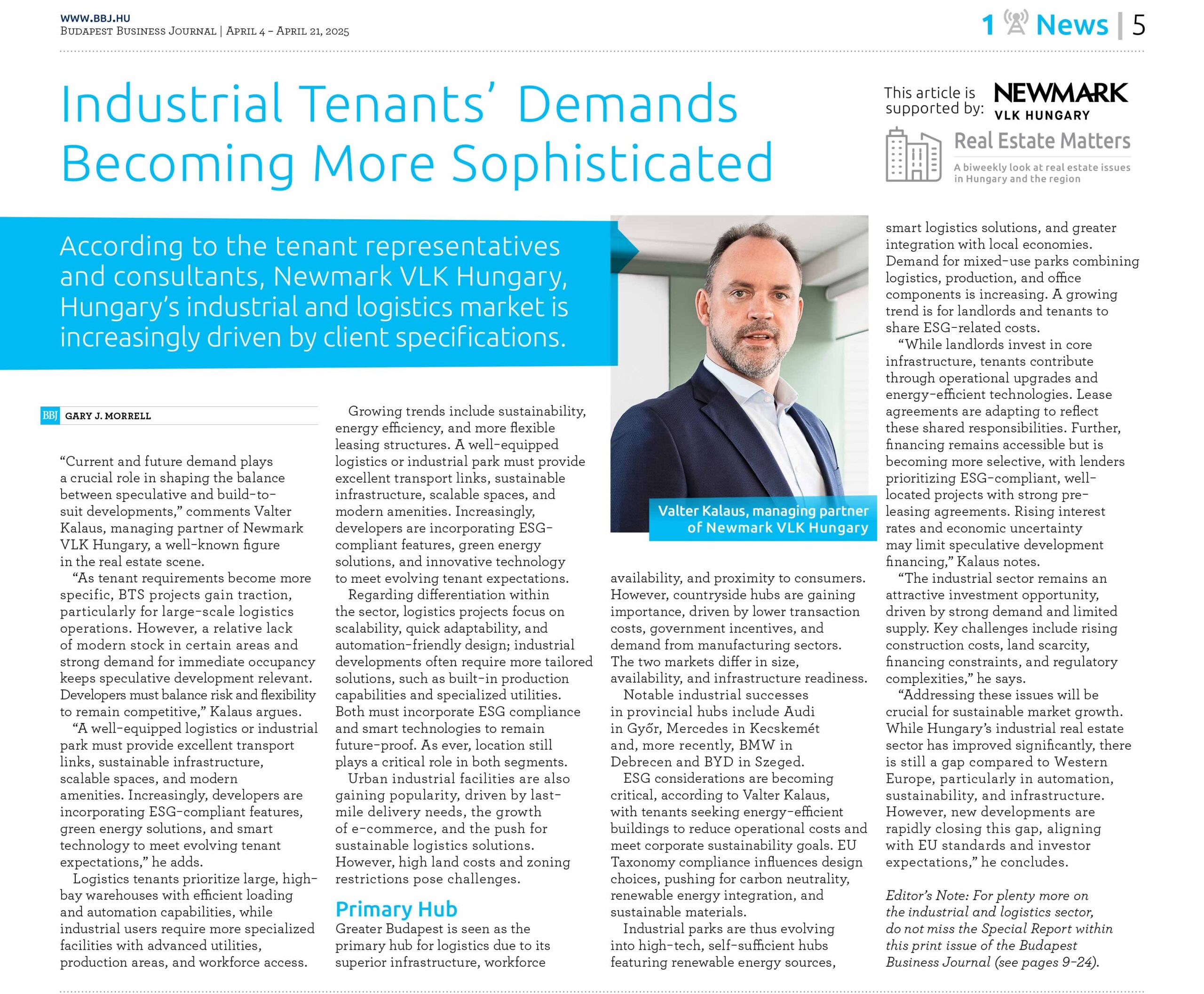
“Current and future demand plays a crucial role in shaping the balance between speculative and build-to-suit developments,” comments Valter Kalaus, managing partner of Newmark VLK Hungary, a well-known figure in the real estate scene. “As tenant requirements become more specific, BTS projects gain traction, particularly for large-scale logistics operations. However, a relative lack of modern stock in certain areas and strong demand for immediate occupancy keeps speculative development relevant. Developers must balance risk and flexibility to remain competitive,” Kalaus argues.
“A well-equipped logistics or industrial park must provide excellent transport links, sustainable infrastructure, scalable spaces, and modern amenities. Increasingly, developers are incorporating ESG-compliant features, green energy solutions, and smart technology to meet evolving tenant expectations,” he adds. Logistics tenants prioritize large, high-bay warehouses with efficient loading and automation capabilities, while industrial users require more specialized facilities with advanced utilities, production areas, and workforce access.
Growing trends include sustainability, energy efficiency, and more flexible leasing structures. A well-equipped logistics or industrial park must provide excellent transport links, sustainable infrastructure, scalable spaces, and modern amenities. Increasingly, developers are incorporating ESG compliant features, green energy solutions, and innovative technology to meet evolving tenant expectations.
Regarding differentiation within the sector, logistics projects focus on scalability, quick adaptability, and automation-friendly design; industrial developments often require more tailored solutions, such as built-in production capabilities and specialized utilities. Both must incorporate ESG compliance and smart technologies to remain future-proof. As ever, location still plays a critical role in both segments.
Urban industrial facilities are also gaining popularity, driven by last-mile delivery needs, the growth of e-commerce, and the push for sustainable logistics solutions. However, high land costs and zoning restrictions pose challenges.
Primary Hub
Greater Budapest is seen as the primary hub for logistics due to its superior infrastructure, workforce availability, and proximity to consumers. However, countryside hubs are gaining importance, driven by lower transaction costs, government incentives, and demand from manufacturing sectors. The two markets differ in size, availability, and infrastructure readiness. Notable industrial successes in provincial hubs include Audi in Győr, Mercedes in Kecskemét and, more recently, BMW in Debrecen and BYD in Szeged.
ESG considerations are becoming critical, according to Valter Kalaus, with tenants seeking energy-efficient buildings to reduce operational costs and meet corporate sustainability goals. EU Taxonomy compliance influences design choices, pushing for carbon neutrality, renewable energy integration, and sustainable materials. Industrial parks are thus evolving into high-tech, self-sufficient hubs featuring renewable energy sources, smart logistics solutions, and greater integration with local economies. Demand for mixed-use parks combining logistics, production, and office components is increasing. A growing trend is for landlords and tenants to share ESG-related costs.
“While landlords invest in core infrastructure, tenants contribute through operational upgrades and energy-efficient technologies. Lease agreements are adapting to reflect these shared responsibilities. Further, financing remains accessible but is becoming more selective, with lenders prioritizing ESG-compliant, well located projects with strong preleasing agreements. Rising interest rates and economic uncertainty may limit speculative development financing,” Kalaus notes.
“The industrial sector remains an attractive investment opportunity, driven by strong demand and limited supply. Key challenges include rising construction costs, land scarcity, financing constraints, and regulatory complexities,” he says.
“Addressing these issues will be crucial for sustainable market growth. While Hungary’s industrial real estate sector has improved significantly, there is still a gap compared to Western Europe, particularly in automation, sustainability, and infrastructure. However, new developments are rapidly closing this gap, aligning with EU standards and investor expectations,” he concludes.
To read more articles visit bbj.hu