• About
    • About
    • Meet the team
    • Tenant representation
    • Career
    • Awards
  • Our services
    • Transaction services
    • Project management
    • Workplace solution
    • Legal Services
    • Service charge audit
    • Valuation
    • Capital Markets
  • Sectors
    • Offices
    • Industrial & Logistics
    • Retail
    • Hotel & Tourism
  • Clients
    • Success stories
    • Videos
  • Knowledge
  • Contact
  • HU
  • Rólunk
    • Rólunk
    • Csapatunk
    • Bérlőképviselet
    • Karrier
    • Elismerések
  • Szolgáltatásaink
    • Tranzakciómenedzsment
    • Műszaki projektmenedzsment
    • Munkahelyi környezetoptimalizálás
    • Ingatlanjogi tanácsadás
    • Üzemeltetési költségvizsgálat
    • Értékbecslés
    • Ingatlanbefektetés
  • Szektorok
    • Iroda
    • Ipari és Logisztika
    • Kiskereskedelem
    • Hotel és turizmus
  • Ügyfelek
    • Sikersztorik
    • Videók
  • Tudástár
  • Kapcsolat
  • HU

Author Archive for verzarkrisztian

In today’s market the successful tenant representative is the one, who can get you the space

By verzarkrisztian
Tuesday, December 10th, 2019

With today’s market conditions tenants are in a more vulnerable position than ever before. You can read some interesting market trends from Valter Kalaus, the managing director of Newmark VLK Hungary.

Valter Kalaus Portfolio cikk
  • What would you recommend to a company who would like to move to a new office within 6-7 months from now?
  • I would tell them there are in a very difficult situation. Almost mission impossible. Office buildings are fully let, the market is heavily dominated by landlords. Total vacancy rate is below 6%, on the Váci corridor it is 2-3%, and on the other main submarkets the demand is strong, there are many competing parties for available spaces. Occupiers are in a vulnerable position: the smaller because landlords cannot commit to 300-400 square meters, the larger only because few thousand square meter office spaces area not available on a short notice. Though the latter are in a better position, as there are few hundred thousand square meter office developments in the pipeline. Developers would not commit with a 1.000 square meter tenant need yet but would sign a prelease agreement for a 4-5 thousand square meters for sure. From those the successful ones will be, who requires less compromise and have a quick decision-making process.
  • Nevertheless, in case the occupier is successful what are the tenant representative expert recommendations before signing a lease agreement?
  • Timing is very important, considering the size, the preparation for a move could start even 2 years ahead. The belief that the real estate market is a slow market. Today, is not true anymore, changes happen fast.
    It’s important to fully understand and appreciate the tasks that are necessary in case of a move or extension. We dedicate tremendous time to understand our client’s business needs, the space that will be needed in couple of years’ times, the special functionality fundamentals and traditional space set up requirements.Valter Kalaus Portfolio cikk 50 legbefolyasosabb
  • What are the common mistakes?
  • For example, when the occupier says: we need 1.000 square meter, and we figure out later the internal space fit-out. We need to think the other way around: first let’s have a look what are the business needs and start planning the internal space fit-out based on the specific requirements. Today the HR department’s involvement in the process is a must. Considering the employment retention, the workspace environment is one of the main active tools. The office space also represents the company, the brand, if the locations and design is good, has an interesting, unique fit-out, then even the business partners recognise it, and employees will talk about how much they like to go to work. We help to find the right location and to create the best internal working environment, if it’s the right choice, we prove that it’s worth paying a 1-2 euro/ square meter higher rent for the right office building and employees are happier to go to work. This way, in case of an office move the employment retention can remain strong, and the recruitment will be easier.
  • In previous times the tenant representative success was measured based on how much total cost saving could he negotiate for the occupier. For example, how many benefits were achieved. Should we forget that today?
  • We should treat carefully the cost saving, as with today’s lease agreement conditions, it’s almost impossible. Today the best tenant representative is, who can get the office space where the occupier wants to be.
  • Why would they need an external help? When they can go online and find the right office building and negotiate themselves the terms.
  • We know well the whole market and see the transactional activity. We know 1-1,5 year ahead if an office space will be free and this knowledge gives us the wining advantage. We are not agents but true advisors, and we don’t find a tenant for an office space, but we find the right office space that fits the occupiers need.
  • Is it right to say that the occupier alone would not be able to get any benefits?
  • Today definitely not, because of the low available space the landlords are comfortable. There are some landlords who give no rent-free period for example. Meantime rents increased with 20-25%, and in some cases after the first proposal, there is even a bid upwards. We can forget the moving contribution, and the extra internal space fit-out contributions.
  • Thus, the landlords blackmail potential is high versus the tenant.
  • This sentence is somewhat strong but is very unfortunate that we see landlords who abuse their current position. To give you an example: there are cases when landlords charge the multiple amount of the fit-out costs, occupiers find themselves in a position where they have no choice, and this is very unfair. A correct landlord would never do something like that. The market will change again in a couple of years and the occupiers will remember how the landlord treated them. And when their lease expiries they will choose another building.
  • This also requires that in the tenant representatives’ team there are technical project managers.
  • Obviously, it’s a must – and we have them in our team. Our well qualified technical project managers very often face poor quality fit-out works, with unrealistically high bills. Clearly, without finance, legal and HR team contribution even we would not be able to add value to the occupier.
  • So far, we talked only about category “A” office buildings. What is the situation in lower categories? Is there a high internal movement, are lots of companies trading up their apartment offices? How much is the “B” category office market changing.
  • The new and the high category will always have its charm. To step up has always a strong message: that the company is strong, growing etc. Between the categories we can find big technical difference. Is much better to work in a WELL certified office building, than in a dilapidated 20 years old building. Obviously in those certified buildings employee’s efficiency increases. However, the property managers of the category “B” office buildings will need to improve, modernize the technical background and the space fit-out as well. There are many and even more items to consider when we calculate if is worth for the occupier to pay 2-3-euro/ square meter higher amount. And this is exactly where we can help the most.
  • Will there be a greater functional change in the office buildings? Possibly would some of these buildings be transformed into hotels, like we have seen in some downtown cases.
  • We can see those changes as well, but I don’t think it will be a massive impact on the office market. I would rather highlight the coworking or shared offices, as a disruptive factor the serviced office functionality office building, that either can be developed in classic office buildings on a few thousand square meters, or they can be opened in downtown apartment buildings.
Categories : Press

Labour shortage reshaping the Budapest office market

By verzarkrisztian
Wednesday, November 6th, 2019

The Budapest office boom remains for the next three years, and by 2022 approximately 600.000 m2 new office space will be added. Though the employment market changes will influence the office market as well: the effect of trying to get the best people, leads to occupiers’ new approach to the office market looking for multifunctional areas instead of the open space office. In addition, office fit-out cost increased substantially with 20-30% to accommodate the new requirements. Despite the increased total modern stock, there is not enough modern office building to meet the Y and Z generation’s employee’s needs, which partly answers the question of office rent increased 25% in Budapest. 

The significant changes on the Budapest office market are the effect of the employment market changes to a certain extent: companies are competing for the best workforce and in this process beside the salary packages the most effective tool that can be used to attract new talent are the modern, attractive office environments – confirms Valter Kalaus, in his latest office market outlook. The effort to retain and attract the best workforce leads to an increase in the office space rents, transformed the office developments, and the HR leader’s role by bringing these more to the front. Based on the company Hungarian market experience today, beside the managing directors and financial directors, the HR directors also get involved in the office space projects. Ten years ago, from 10 projects only 2 times were the HR directors involved, whereas today from 10 transactions 6-7 times HR directors are heavily involved in the process. HR directors not only need to be involved but we see signs that become the leaders of the office projects – affirms Valter Kalaus.

Budapest’s modern office stock increased with 20% in the last 3 years, exciding 3,6 million square meters. The Newmark VLK Hungary expert believes that this market growth will last in the next 3 years considering the development pipeline, with a 150.000 – 200.000 m2 new office space to be delivered every year. A total of approximately 600.000 m2 modern office stock increase is expected, which is approximately another 15% increase. With the modern office stock boost thus, there is a significant increase in rents and fit-out costs as well, and a further increase can be expected. Valter Kalaus points out an interesting market contradiction: despite the 25% rent increase in the last 3-4 years, the new modern office spaces are more in demand than the older offices, and despite the additional supply there is not enough good quality new office space available in the capital.

“In an average market transaction, the occupiers are looking for 700-800 m2 office space. 3-4 years ago, occupiers could choose from 6-8 good options, whereas today there is only 3-4 realistic options available and they must compete with another 2-3 potential tenants for it.” – points out Valter Kalaus the challenge. Based on Valter’s market experience in 2016 on the Váci corridor, one of the most attractive office locations, the average office rent was around 13 EUR/m2 for an “A” category office building. Today this is around 16-17 EUR/m2 which is a drastic change considering all the new supply. There is much more money spent on the new office buildings on the design, and technical background to allow more natural light, more fresh air to increase employees comfort. Office fit-out costs increased 20% in the last three years in order to help employment retention. For example, for an IT company the total office fit-out cost today can reach up to 800- 1.000 EUR/m2.

The employment changes have a massive impact on the real estate developments. 5 years ago, from 10 office fit-out in 9 cases open space layout was selected, instead of cubical solution – trying to save space – today from 10 office fit-out in 8 cases the preference is the multifunctional zones. Reason behind this being that the Y and Z generations don’t accept the classic working model, ie sitting behind a desk, and computer working style. Developers need to also accommodate services that match Y and Z generation needs: today the easy accessibility and the cheap canteen in the office buildings are not enough, the trendy cafes and good quality restaurants serving healthy food are a must in the new office projects – says Valter Kalaus.

Based on the expert opinion the HR director’s realised that the office space can be used as an efficient HR strategic tool, and not only the salary packages can help in the employment retention, and recruitment. However, the HR director’s real estate experience is limited. In the past mainly the companies above 200 employees used real estate advisor, today more and more companies with 50-300 employees tend to use external help.

To read the HU article please click here. 


Categories : Press

Office demand remains strong across Europe. Signs of an economic slowdown are already visible.

By verzarkrisztian
Monday, October 7th, 2019

What’s next for the office market? What do occupiers want? What effect would an economic slowdown have on development? Heads of the European offices of real estate advisory firm Cresa talked about business opportunities and risks, and the global political uncertainty at their annual conference in Warsaw.

A slowdown, but no slump

Europe is already experiencing the first signs of an economic slowdown that has so far had a limited effect on the office market, say several heads of Cresa’s European offices commenting on the situation in their respective countries. After Germany, this trend is most pronounced in the Netherlands. “Some companies, especially in the automotive sector and suppliers in the high-tech industry, are seeing their order books starting to run empty. As a result, some of our clients are preparing for a downturn in the market,” says Johan Martens, Director of Cresa in the Netherlands. “In the past year we have experienced strong growth in the office market. However, in certain parts of the country this has been restricted by the limited supply of new construction. The focus of growth is primarily on areas of the Randstad: Amsterdam, Rotterdam, The Hague and Utrecht, with a run-out towards the medium-sized cities outside the Randstad.”

Poland and Spain appear the most resilient to the wider economic slowdown, which has had no impact on their office markets. Office demand stays strong in France. “2018 was still a very good year with take-up at around 2,5 million sqm, which was 230,000 sqm above the ten-year average. There were as many as 81 large lease transactions of spaces over 5,000 sqm. The vacancy rate across the main market of Île-de-France is currently at 5.3%, and 1.8% in Paris, the lowest level in ten years. Nevertheless we can observe that the office take up had decreased by 15% in the first half of 2019, due to the scarcity of office supply in particular,” says Thibault de Gueltzl, Managing Director, Cresa France.

Valter draft web

A landlord’s market

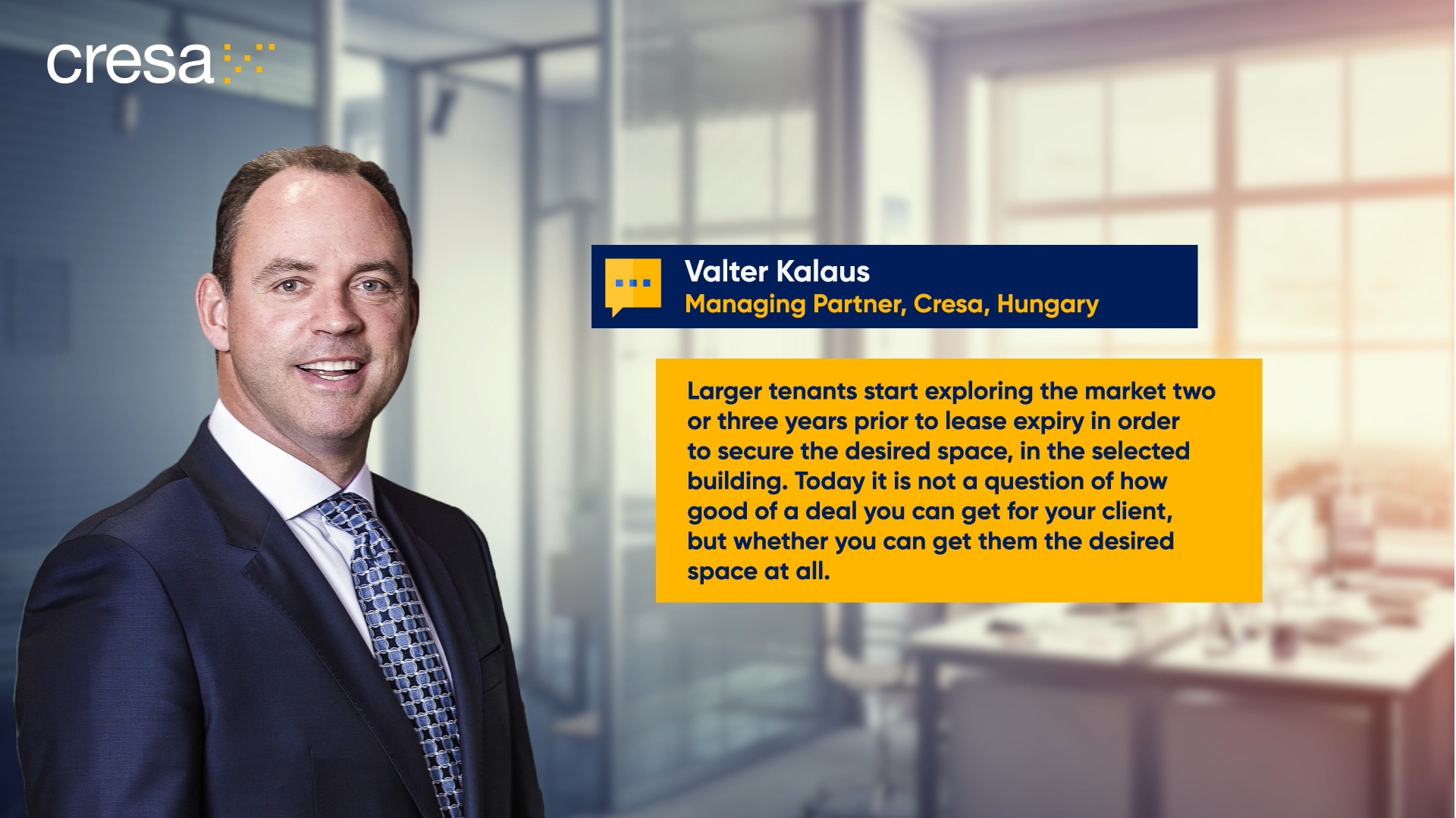
According to the heads of Cresa in Central and Western Europe, the regional office market still has a big potential. Most say that their respective markets are either balanced or skewed towards the landlord. This is very pertinent for the office market in Hungary. Its average vacancy rate is just 6.5% and office rental rates are soaring, whilst lease incentives are being scaled down. “There is a large amount of construction going on and major pre-lets are being signed. Larger tenants start exploring the market two or three years prior to lease expiry in order to secure the desired space, in the selected building. Today it is not a question of how good of a deal you can get for your client, but whether you can get them the desired space at all,” says Valter Kalaus, Managing Partner, Cresa Hungary.

 In Spain, high-quality office spaces in central locations are clearly favoured. “That’s why in Madrid there is currently a strong imbalance between supply and demand. Tenants want top quality buildings in prime, central locations, but there’s a paucity of such real estate to meet the demand. The same goes for Barcelona. To satisfy that demand, landlords have to upgrade their office buildings,” says Cruz Guijosa, Director of Cresa in Spain. “As Madrid has no vacant sites in the city centre, office development is spreading further away. The delivery of new office buildings is expected to restore the supply demand balance, even though new projects will be developed in non-central locations.”

A quick response to occupiers’ needs
The Belgian office market is a bit different – tenants enjoy the upper hand in a market that has an oversupply of vacant older buildings in some locations. In addition, companies are downsizing their offices. “Office tenants continue to focus on cost reduction and creating a flexible work environment in order to attract and retain employees. On the other hand, landlords are trying to add new services in their business parks such as flexible desks, meeting zones or catering facilities to attract and retain tenants. This will enable tenants to downsize rented offices to make savings, to use such services as required and better align their spaces with their needs,” explains Anthony Huygen, Partner, Cresa Belgium.

An office in the EU

Brexit continues to represent an opportunity for European cities to attract new office tenants. There are many financial firms that are required to have an office in an EU jurisdiction to undertake certain operations – for others it could simply be a more viable business option. The Netherlands has already benefited from these changes: approximately 100 companies have opened branches in the country due to the impending Brexit. The UK’s departure from the EU has also had some impact on the Polish and French office markets. Despite uncertainty that emanates from Brexit, office markets around the UK and in particular the major London market continue to record strong tenant demand.

A move towards flexible leasing
IT and high-tech sectors have been increasing employment for some time and remain key drivers of the office market across Europe. These are leading sectors according to respondents from France, Hungary, Poland and the UK. The latter two have also seen financial institutions very active on their leasing markets. In France, office demand remains boosted by start-ups, whilst in Belgium – it is by the public sector. Whilst office demand has been robust around Europe, the fundamentals of how space is used and leased is evolving with propensity for businesses to seek out more flexibility with their real estate.

The growth of shared office spaces or co-working is a relatively new trend in some parts of Europe, but is gathering pace. In the first half of 2019, co-working operators accounted for approximately 8% of absorption in the Spanish office market. Cities currently leading the co-working drive in Europe include London, Paris and Warsaw. In the first half of 2019, coworking represented 62% of the take up for the largest transactions in Île-de-France.

 “It is not just co-working but a whole range of flexible leasing solutions that has taken the UK market by storm. In London alone there are over 600 operators offering flexible space. Focus for operators is now on other UK cities in order to gain greater coverage. Occupier demand for this type of space is at the moment keeping a good pace, with co-working centres reporting healthy occupancy rates of 80-90%,” says Shaun Dawson, Head of Insights at DeVono Cresa, UK.

What’s next?

How will Poland perform in the current macroeconomic situation? Will it also be hit by the economic slowdown? “We are well aware of the impact of global politics and the economy on our country – yet there are many question marks and uncertainties that remain. What’s next with Brexit and ongoing trade wars? Will the economic conflict between the US and China have a knock-on effect on our biggest trading partner Germany and indirectly on Poland?” asks Piotr Kaszyński, Managing Partner, Cresa Poland. “As it’s difficult to answer these questions specifically, we are focusing instead on Poland’s strong performance – there are no signs of any slowdown. The office market is setting new highs. In the second quarter of 2019, Warsaw’s office take-up topped 265,000 sqm, the highest quarterly volume on record. The business services sector is growing at a rapid pace both in the capital and regional markets. There is a marked increase in the number of mixed-use projects and development activity is being driven by strong investor interest,” concludes Head of Cresa Poland.

Categories : Press

Hotel boom on the European real estate market

By verzarkrisztian
Friday, September 27th, 2019

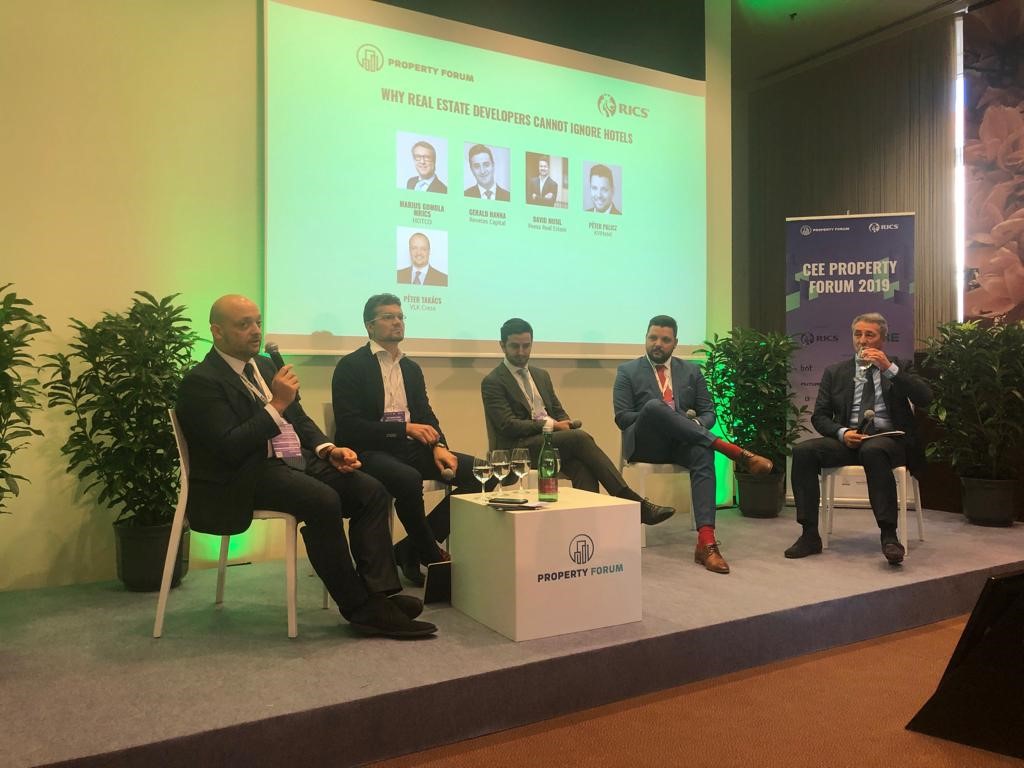
At the CEE Property Forum 2019, held in Vienna on 18-19 September, was set as a goal to gather the leading decision makers of the European and CEE property world to discuss the major trends and future of their industry. CEOs, influential investors, bankers, advisors, developers, fast-growing proptech startup founders, architects, valuers from more than 30 countries.

Peter Takacs

With the boom in tourism, the hotel market in the region offers a wealth of opportunities, while becoming an increasingly attractive asset for investors. Tourist needs are changing rapidly with the spread of low-cost airlines and accommodation services, but the CEE region is by far the best market for hotel developments. The conference provided an opportunity for cross-industry dialogue, panel discussions with European investors and a Central European banker roundtable.

STA 0225 scaled

At the two-day conference, Newmark VLK Hungary was represented by Péter Takács, who has a unique experience, combination of opening and operating a hotel chain and having an international real estate consultancy background also. At the roundtable discussion, our partner, based on experience from recent hotel projects, confirmed that the hotel acquisition market is buzzing today in Poland and Hungary the market is very active, everyone wants to buy an operating hotel but it is difficult to find a good product at a fair price. Fortunately, the rental scheme is spreading, which attracts institutional investors and family offices as well, and almost all banks are happy to finance these projects, as the cash-flow is more predictable.

In the hotel development fever, brands have been launched in Hungary that do not yet have a unit in Budapest. They still prefer management-based management contracts and higher risk developers, banks and investors are actively negotiating with them. The burgeoning investment market for office buildings and falling yields are also diverting those interested in the hotel market. Primary the tourist performance indicators, the relatively lower prices and more attractive returns in the region attract customers, but it is just as important for the tenant, the rent to be predictable as for an office or commercial property.

In Hungary, developers also see increasing potential in hotels, both domestic and international players are expanding in this area, but for the time being, the capital is still the target area. Because the number of the good locations is decreasing, we can see it already, and we will see more and more the feature switch in projects, when an office building or a condominium becomes a hotel.

Thanks to our experience in hotel development, Newmark VLK Hungary has been involved in several internationally recognized projects. We are proud that we also contributing to the development of Budapest and Hungary by opening new hotels and catering units.

To find out more click HERE 

Categories : Press

a&o is building a strong presence in Budapest

By verzarkrisztian
Monday, July 29th, 2019

a&o Hotels and Hostels, one of the largest European hostel companies is about to establish a strong presence in Budapest, according to Péter Takács, Partner of Newmark VLK Hungary, who said that the chain’s 114-room, 412-bed hostel is scheduled to open in the city center of Budapest in March 2020 in district seven Csengery street.

One or two months of delay could be possible due to the current lack of local construction capacity, but it is certainly not holding back the company from building out a strong presence in the longer term, planning with up to one thousand beds in the Hungarian capital. Their first property is owned by a&o, future properties will most likely be operated on a lease basis.

To find out more click HERE 

Categories : Press

The new challenge in the Real Estate Sector

By verzarkrisztian
Saturday, March 16th, 2019

There is a rapidly spreading new buzz on the real estate market: proptech. The Budapest Proptech Forum conference had a high interest which proves that we have to seriously consider this subject. The Newmark VLK Hungary leaders participated at the conference and they reflect on this topic.

How much does the market understand what proptech is?
Valter Kalaus: This is a hot topic now for tenants, developers and landlords. Everybody is trying to understand what it means exactly for them, when and how much it would influence and change their areas in the near future. For most is not crystal clear yet what kind of applications and new technology-driven solutions exist and how these could benefit them. The conference provided a platform to discuss these topics and the various different views.

How Newmark VLK Hungary can help clients with proptech?
Valter Kalaus: At Newmark VLK Hungary we are prepared for this new challenge. We help our clients to navigate and find the potential right solution among the various proptech options available. After understanding their specific needs we propose available and suitable options and tools, based on international innovation examples. It is important to propose solutions that fit our clients’ business goals and interest the best way.
Using the right proptech tools in the workplace can clearly help to be more attractive to employees – and the new generation is demanding this – but too much of it can easily backfire.

How open is the Hungarian market to this innovation?
Valter Kalaus: I think Hungary is somewhat behind compared to other mature, mostly Western European markets, but we can definitely feel the wind already. People want to know more and more about proptech in general and about the various available options. We are still in the learning phase, but the interest is growing fast. Proptech will definitely play an important role in the real estate sector, it cannot be ignored. The Hungarian market generally is price sensitive, therefore the price-tag can play an important role in the selection process of the desired solution. It seems, however, that we will need another year or two until the various proptech solutions will be commonly used on the Hungarian real estate market.

STA 8158 1
STA 8099

What was new on the Budapest Proptech Forum conference?
Péter Takács: Proptech is a buzzword – the market players are trying to discover what they could use property technology for in their respective field so that it benefits them. From the presentations it was clear that there are advanced efforts in all areas but there are not many solid solutions yet that can be widely adopted. Proptech can certainly have a significant impact on our sector, however property is a long term investment product, and we do not yet see its direct impact. But if we consider how the internet and mobile phones changed all aspects of our lives, proptech can be a similar milestone, and even if concrete cannot be digitised, the property sector needs to adopt tech solutions.

How does Newmark VLK Hungary help clients with proptech?
Péter Takács: We follow the trends, new proptech products and services, we test them from our clients point of view, so that we can deliver the best solutions that fit their business interests and objectives. We introduce all the interesting new solutions to our clients, and often they turn to us whether a certain product, or solution would be beneficial for them. Up till now companies have been mainly interested in increasing operations effectiveness and to optimise cost, and only recently they have started moving towards creating a more attractive and efficient workplace  environment. We believe that only those proptech solutions will be successful that will service both these areas.

What are companies interested in ?
Péter Takács: Most of the clients are very much return-on-investment oriented, therefore proptech solutions will need to demonstrate solid ROI track record numbers in order for customers to engage with them, especially if they promise optimizing property costs. However we see more openness towards proptech solutions related to the workforce, because the value of competent and loyal workforce has increased significantly and as HR costs are still higher than property related costs, a lower return in investment in the prior represents more significant effect on the latter. And we are happy to see that HR managers who previously failed to successfully lobby with top management regarding workplace improvements are now more successful because ownership and management both understand that investing in the workforce is a must, and as they produce their added value in the office environment it is more important now how the workplace supports them, and this is where proptech can help the most.

Is proptech more advanced in the hospitality sector?
Péter Takács: Ultimately the hotel business is also a real estate business, however the internet and technology brought noticeable impact and simplified searching, booking and paying for a room earlier than in other property businesses. Leasing or buying an office for hundreds of people is a much higher value transaction and a more complex process than booking a weekend trip, however good proptech solutions should help in simplifying this complexity. Serviced and co-working offices show good examples, especially since not only startups and freelancers are using them but also larger corporations – exactly because the providers have standardised their offering enough to make searching, booking and paying more simple.

How long can be the protech learning phase?
Péter Takács: The learning phase is probably long, but it also depends on an organisation’s agility. If you are good with things staying as they are and do not invest now, and do not try new things, you save on the short term but you could fall behind in the long term. So it could take years, but it can also happen that a developer, an investor, a tenant or an advisor will bring a new solution tomorrow which gets adopted widely and will spread quickly. One thing is for sure: an attitude change is needed. In my opinion everybody will soon realise, that it is better if you try to develop or test new technology solutions, instead of waiting for everything to change by itself and hope this to be good for you. If we compare the learning curve to that in the hospitality sector then everybody should engage with technology as quickly as possible because in the world of hotels if you did not act or react quickly enough you lost significant competitive advantage. You don’t want that to happen to you now.

Categories : Press

Europe’s largest private owned hostel chain market entry to Budapest

By verzarkrisztian
Tuesday, November 20th, 2018

Europe’s largest hostel chain a&o is set to open its first property in Budapest. The company has been searching for suitable properties for a year and found the right building in the vibrant part of district 7, with the help of Newmark VLK Hungary.

Built in the early 20th century the building was previously used for residential, office and lately student housing purposes and is now being transformed into a fully refurbished hostel featuring 108 rooms with 412 beds, attracting tourists looking for lower budget, but quality accommodation. The hostel with feature family and dorm rooms and is expected to open in Q3 2019.

a&o hostel Budapest
AO Family Room p
AO Twin p

Read More→

Categories : Press

Our latest expert article about WELL Offices was published in Budapest Business Journal

By verzarkrisztian
Tuesday, October 2nd, 2018

Our latest expert article – that we made together with MN6 energy agency – about the WELL office concept was published in BBJ. The article focuses on a number of up-to-date and interesting issues about the WELL office concept. The article points out, among other things, what benefits a WELL agency offers to companies, how much it would cost to obtain such a qualification, and which office buildings in Budapest have received the WELL pre-qualification.

Categories : Press

Valter Kalaus – Medal Rain at the 17th FINA Masters World Championships

By verzarkrisztian
Wednesday, August 23rd, 2017

Our colleagues are not only masters of the real estate market, but have a great talent for water sports as well. Our market experts performed fabulously at the recently ending 17th FINA Master World Championships swimming events and water polo games. Managing Director, Valter Kalaus reached stunning results in the 45-49 age group, collecting 7 medals and new records. Senior Project Manager, Miklós Tóth-Deme finished in 4th place in the 40+ category with his water polo team, Oázis SC.


Valter Kalaus decided just one year ago to enter the FINA Masters Championships’ swimming events, recently organized in Budapest. The Seoul Olympics participant and former junior European champion prepared for the games with steadfast determination, which brought incredible results: he collected seven medals from all seven events. Kalaus performed with such skillful ease, reaching records – 100 m freestyle world record, 200 m and 400 m national record – even the younger age groups would long for. The Budapest Honvéd Swimming Club’s swimmer stepped on the podium 6 times altogether with 3 gold medals (100 m, 200 m, 400 m – all freestyle), and 3 silver medals (3 km open water, 800 m freestyle, 4×50 m mix freestyle). He also reached an outstanding 4th place in the 4×50 m mix medley with his team.


„To be honest, it wasn’t easy to balance my nearly one-year preparation with family and work, but now that the Masters events have ended with such success, I can surely say that it was well worth it. My goal was to step on the podium in all individual events, and I managed to achieve this to the maximum. I am very satisfied, and I am very grateful to everyone who helped in my preparation this past year” – said Kalaus about his participation.


Miklós Tóth-Deme, and his team, Oázis SC gave a brilliant performance at the water polo games. After tireless clashes with top teams, they reached 4th place advancing from the group to the best 8, then to the best 4. The semi finals match was against Millennium, the multi-talented former Hungarian Olympic team. Although Oázis SC lost the game, they reached the closest results. Later, Millennium succeeded to become the world champion team in the 40+ age group. Oázis SC’s 4th place is considered a very strong result among such world-class water polo teams. Tóth-Deme, as playmaker, practically played through all the games, supporting his team with very useful passes and important goals.


„Besides being about sports, achieving results and promoting health, the Masters events are also about experiencing the respect and bond among athletes. That’s what we felt during the Budapest Championships, and it was a wonderful experience. Not only because we were able to score great results in front of a home crowd and we got the chance to play against Millennium, but also because the Championships were very well organized. While I am pleased with our team’s preparation, our game and my own performance, we know that there is no stopping in improving ourselves to higher levels” – added Tóth-Deme.

Categories : Press

SSCs Need the Right Representation to get the Right Space

By verzarkrisztian
Tuesday, June 20th, 2017

From a landlord’s perspective, shared service centers make near perfect tenants given their demand for large floorplates and typically long-lease periods. That makes it all the more important SSCs have good representation when looking for a property, says Valter Kalaus of tenant representation specialists Newmark VLK Hungary.

Hungary has become a preferred location for SSC largely because of labor costs, Kalaus says, and a ready availability of young people with good language skills, especially beyond the relatively common German or English. And if SSCs like Hungary, landlords in Hungary certainly like SSCs.

“With average leases between three and five years, SSCs tend to sign for a longer-term,” Kalaus explains. “The amount of IT infrastructure they put in makes them less likely to move, and that gives a feeling of greater comfort to the landlord.”

The sector also represents a sizeable share of the overall office market. Some 90 companies have around 100 SSCs in Hungary, mostly in Budapest, although secondary markets are beginning to develop. Collectively those centers employ around 40,000 people, the managing partner explains. Translate that into area, and it comes to 400,000-500,000 square meters of office space. “In other words, 10-12% of the entire Budapest office space is leased by SSCs and this ratio is even higher in the countryside.”

So, in theory, once established, SSCs tend to stay put, securing a large chunk of space for the landlord. But SSCs also expand, especially over the initial two-three years of establishment, and that can bring a few growing pains. “Moves come when an SSC is not able to expand within the building.” Flexibility is key here; Kalaus says an average office rental is for 700-800 sqm; a typical SSC is more likely to need 1,000 – 3,000 sqm, but not all at once. Staff numbers – and thus the need for more space – are ramped up over time.

“Selecting the right building, working with the right advisor who can give unbiased opinion of what building, what property and what location is best for their business is key to the SSC’s success,” the real estate professional says.

Room to Expand

Each client has their own needs, Kalaus says. Exact equations change from deal to deal, but location is important (staff need easy access to their work place), as is availability of the right kind of skill sets, and room to expand as required. This latter point, in particular, requires knowledge of a building. “You need to know the building; there might be space on the second floor because someone has moved out. You need to know the tenants opposite or above, to know who might be moving out in a year’s time.”

If these are challenges in Budapest, they are even more so in the countryside, because second-tier markets are only now starting to launch speculative developments. The 22,000 sqm Forest Offices in Debrecen, due to be delivered in the third quarter of 2018, is particularly significant in this regard, in that it is the first speculative office building outside of Budapest since the financial crisis.

“More recently we are seeing SSCs going to second-tier cities like Debrecen, Szeged, and Pécs, based on good universities in cities where there are young people willing to work in such centers.”

Finding office space, particularly with flexibility on availability, remains something of a chicken-and-egg challenge, Kalaus says. Even for a built-to-suit project, landlords want a tenant who will be in place for longer than just a few years. They may also want at least the possibility of exiting in the long-term, and that requires liquidity in the local market. And tenants, particularly SSCs, need to know there will be space available for them if they wish to expand.

But the challenges are worth overcoming. With so many new developments up for grabs, SSC tenants should be very prudent of the choice they make in order to find the best building and make the best deal.

“I personally have done a number of SSC deals, in Budapest and the countryside for big companies like AVIS, AGCO, Cemex and SEI. They are very interesting projects; they usually have very good teams established internally. They make for good tenants and good clients.”

Source: BBJ.hu

Categories : Press

nmrk.com

Adatkezelési tájékoztató
Honlaphasználati feltételek
Impresszum

Kapcsolat

Newmark VLK Hungary
Váci út 45. | Átrium Park Irodaház
„D” épület 8. emelet
1134 Budapest

+36 1 632 1400 hungary@nmrk-global.com

Oldaltérkép

  • Szolgáltatások
  • Ügyfeleink
  • Tudástár
  • Kapcsolat

Kövess minket

Tagságok

A Newmark VLK Hungary, a Newmark Global partnereként, tagja a Newmark Global hálózatnak.

© Newmark VLK Hungary

created by verzar

nmrk.com

Privacy notice
Terms of Use
Impressum

Contact

Newmark VLK Hungary
Váci út 45 | Átrium Park Office
D building 8th floor
1134 Budapest

+36 1 632 1400 hungary@nmrk-global.com

Sitemap

  • Services
  • Clients
  • Knowledge
  • Contact

Follow Us

Membership

Newmark VLK Hungary, a Newmark Global Partner, is a member of the Newmark Global Network.

© Newmark VLK Hungary

created by verzar